# size of sample:
n <- 20
m <- 5

# model parameters:
beta_0 <- 0
beta_1 <- 1
sigma_0 <- 2
sigma_1 <- 1
sigma_2 <- 5

# construct data:
patients <- tibble(patient_id = 1:n,
                   patient_re = rnorm(n, 0, sigma_1),
                   treatment_re = rnorm(n, 0, sigma_2))

dat <- expand_grid(patients,
                   replicate = 1:m,
                   timepoint = c('pre', 'post'))

dat <- dat |>
  mutate(y = beta_0 +
           patient_re +
           ifelse(timepoint == 'post', treatment_re + beta_1, 0) +
           rnorm(n * m * 2, 0, sigma_0))

# make timepoint a factor to get order in plots right:
dat <- dat |>
mutate(timepoint = factor(timepoint, levels = c('pre', 'post')))Specifying mixed effects in lme4
R
Description of trial
- \(n\) individuals (\(i = 1, 2, .., n\)) are measured \(m\) times (\(j = 1, 2, ..., m\)) pre-intervention (denoted \(y_{ij}^{pre}\)) and post-intervention (denoted \(y_{ij}^{post}\))
Underlying probability model
Notation
- \(\beta_0\) fixed effect intercept
- \(\beta_1\) fixed effect of intervention
- \(\epsilon \sim \mathcal{N}(\mu = 0, sd = \sigma_0)\), for reasons of better legibility sub- and superscript are omitted here
- \(b_{1,i}\) random effect baseline, \(b_{1,i} \sim \mathcal{N}(\mu = 0, sd = \sigma_1)\)
- \(b_{2,i}\) random effect of intervention, \(b_{2,i} \sim \mathcal{N}(\mu = 0, sd = \sigma_2)\)
Parameters of the model to be estimated
- \(\beta_0\), \(\beta_1\), \(\sigma_0\), \(\sigma_1\) and \(\sigma_2\)
Model equations
- Measurement pre intervention: \[\begin{align} y_{ij}^{pre} = \beta_0 + b_i + \epsilon_{ij}^{pre} \end{align}\]
- Measurement post-intervention: \[\begin{align} y_{ij}^{post} = \beta_0 + \beta_1 + b_{1,i} + b_{2,i} + \epsilon_{ij}^{post} \end{align}\]
Simulate data
Tabular characteristics
dat |>
  group_by(timepoint) |>
  summarize(mean = mean(y)) |>
kable()| timepoint | mean |
|---|---|
| pre | 0.1868025 |
| post | 1.1930561 |
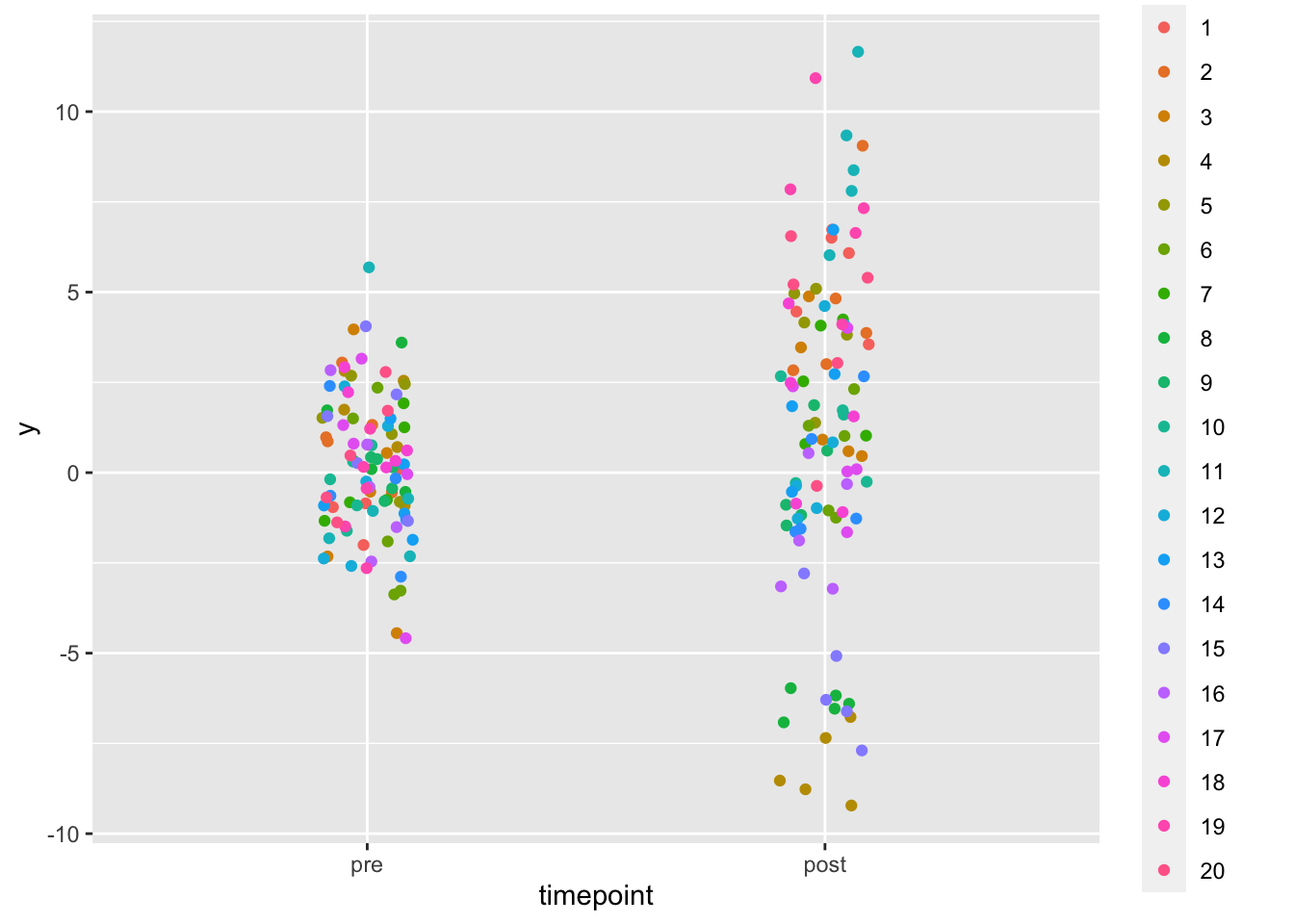
Visualize data
if(n < 1e2) {
  dat |>
    ggplot(aes(timepoint, y, col = factor(patient_id))) +
    geom_jitter(width = 0.1, height = 0) + labs(color = 'Patient ID')
}
Fit model
Linear model
# linear model to get beta_1 and beta_2
(fm_lm <- lm(y ~ timepoint, data = dat)) |> summary()
Call:
lm(formula = y ~ timepoint, data = dat)

Residuals:
     Min       1Q   Median       3Q      Max
-10.4127  -1.5931   0.0072   2.0727  10.4653

Coefficients:
              Estimate Std. Error t value Pr(>|t|)
(Intercept)     0.1868     0.3489   0.535   0.5930
timepointpost   1.0063     0.4934   2.039   0.0427 *
---
Signif. codes:  0 '***' 0.001 '**' 0.01 '*' 0.05 '.' 0.1 ' ' 1

Residual standard error: 3.489 on 198 degrees of freedom
Multiple R-squared:  0.02057,   Adjusted R-squared:  0.01563
F-statistic: 4.159 on 1 and 198 DF,  p-value: 0.04274
Mixed effects model with correlation between (Intercept) and timepointpost
(fm_lmer <- lmer(y ~ timepoint + (timepoint | patient_id), data = dat))boundary (singular) fit: see help('isSingular')Linear mixed model fit by REML ['lmerMod']
Formula: y ~ timepoint + (timepoint | patient_id)
Data: dat
REML criterion at convergence: 888.5308
Random effects:
Groups Name Std.Dev. Corr
patient_id (Intercept) 0.3268
timepointpost 4.5307 -1.00
Residual 1.9086
Number of obs: 200, groups: patient_id, 20
Fixed Effects:
(Intercept) timepointpost
0.1868 1.0063
optimizer (nloptwrap) convergence code: 0 (OK) ; 0 optimizer warnings; 1 lme4 warnings Mixed effects model without correlation between (Intercept) and timepointpost
- The specifications I tried seem almost right, but not quite:
(fm_lmer <- lmer(y ~ timepoint + (timepoint - 1 || patient_id), data = dat))Linear mixed model fit by REML ['lmerMod']
Formula: y ~ timepoint + ((0 + timepoint | patient_id))
Data: dat
REML criterion at convergence: 888.5308
Random effects:
Groups Name Std.Dev. Corr
patient_id timepointpre 0.3268
timepointpost 4.2038 -1.00
Residual 1.9086
Number of obs: 200, groups: patient_id, 20
Fixed Effects:
(Intercept) timepointpost
0.1868 1.0063 (fm_lmer <- lmer(y ~ timepoint + (timepoint - 1 | patient_id), data = dat))Linear mixed model fit by REML ['lmerMod']
Formula: y ~ timepoint + (timepoint - 1 | patient_id)
Data: dat
REML criterion at convergence: 888.5308
Random effects:
Groups Name Std.Dev. Corr
patient_id timepointpre 0.3268
timepointpost 4.2038 -1.00
Residual 1.9086
Number of obs: 200, groups: patient_id, 20
Fixed Effects:
(Intercept) timepointpost
0.1868 1.0063 (fm_lmer <- lmer(y ~ timepoint + (1 | patient_id) + (timepoint - 1 | patient_id), data = dat))boundary (singular) fit: see help('isSingular')Linear mixed model fit by REML ['lmerMod']
Formula: y ~ timepoint + (1 | patient_id) + (timepoint - 1 | patient_id)
Data: dat
REML criterion at convergence: 888.5308
Random effects:
Groups Name Std.Dev. Corr
patient_id (Intercept) 0.0000
patient_id.1 timepointpre 0.3268
timepointpost 4.2039 -1.00
Residual 1.9086
Number of obs: 200, groups: patient_id, 20
Fixed Effects:
(Intercept) timepointpost
0.1868 1.0063
optimizer (nloptwrap) convergence code: 0 (OK) ; 0 optimizer warnings; 1 lme4 warnings (fm_lmer <- lmer(y ~ timepoint + (1 | patient_id) + (timepoint + 0 | patient_id), data = dat))boundary (singular) fit: see help('isSingular')Linear mixed model fit by REML ['lmerMod']
Formula: y ~ timepoint + (1 | patient_id) + (timepoint + 0 | patient_id)
Data: dat
REML criterion at convergence: 888.5308
Random effects:
Groups Name Std.Dev. Corr
patient_id (Intercept) 0.0000
patient_id.1 timepointpre 0.3268
timepointpost 4.2039 -1.00
Residual 1.9086
Number of obs: 200, groups: patient_id, 20
Fixed Effects:
(Intercept) timepointpost
0.1868 1.0063
optimizer (nloptwrap) convergence code: 0 (OK) ; 0 optimizer warnings; 1 lme4 warnings