set.seed(1)
library('neuralnet')
library('tidyverse')
library('knitr')Bivariate dataset - linear regression and neural net
R
Linear model vs neural nets
Basic neural net
Init
We are looking at the cars dataset (more about the dataset via help(cars))
distis the stopping distance (not what I said today)
cars |>
  ggplot(aes(dist, speed)) +
  geom_point()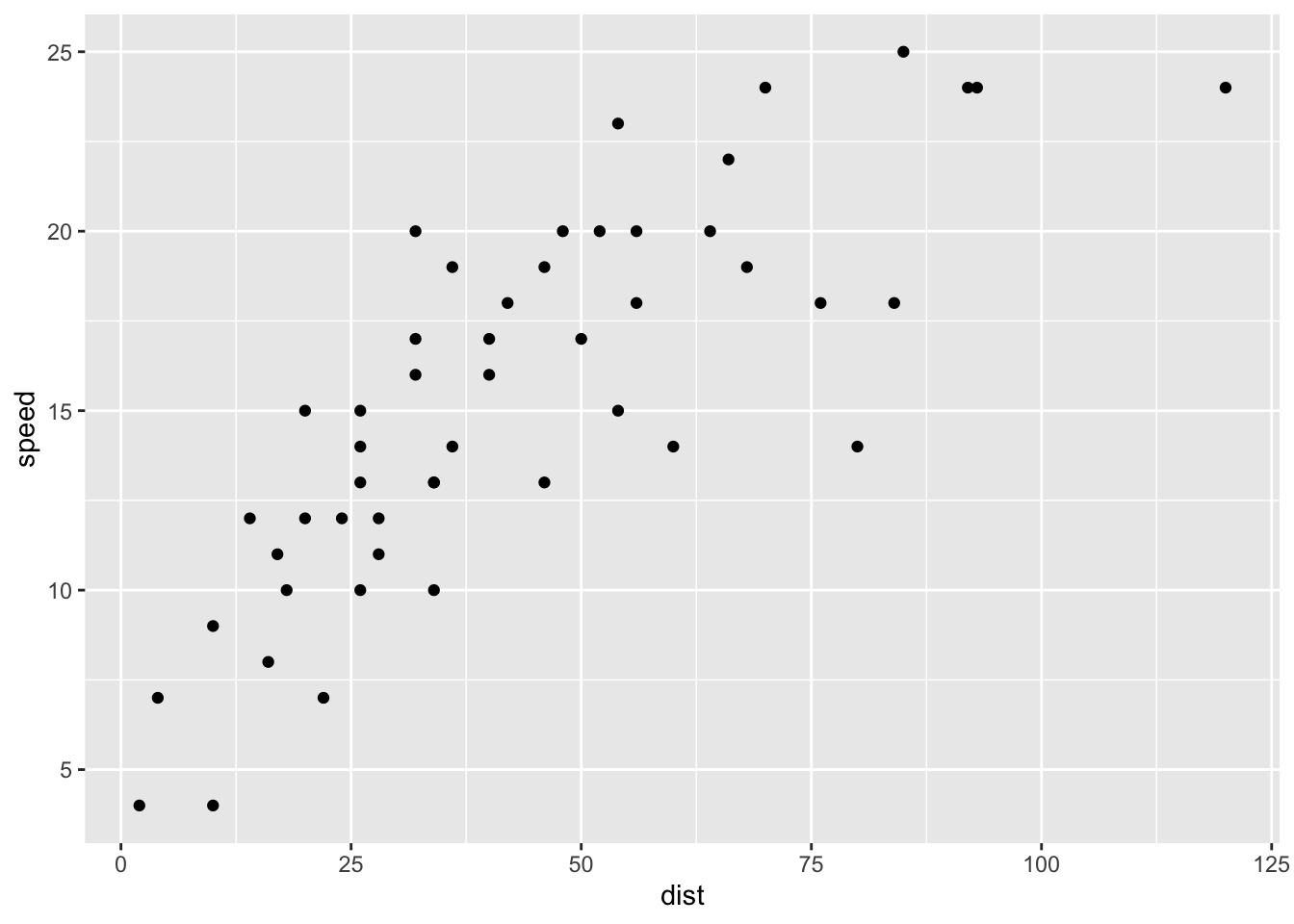
We can fit a linear regression model:
fm_lm <- lm(speed ~ dist, data = cars)
summary(fm_lm)
Call:
lm(formula = speed ~ dist, data = cars)

Residuals:
    Min      1Q  Median      3Q     Max
-7.5293 -2.1550  0.3615  2.4377  6.4179

Coefficients:
            Estimate Std. Error t value Pr(>|t|)
(Intercept)  8.28391    0.87438   9.474 1.44e-12 ***
dist         0.16557    0.01749   9.464 1.49e-12 ***
---
Signif. codes:  0 '***' 0.001 '**' 0.01 '*' 0.05 '.' 0.1 ' ' 1

Residual standard error: 3.156 on 48 degrees of freedom
Multiple R-squared:  0.6511,    Adjusted R-squared:  0.6438
F-statistic: 89.57 on 1 and 48 DF,  p-value: 1.49e-12
We can do basically the same thing using a neural net with a single perceptron
- Note that the coefficients of the linear regression model are (almost) identical to the weights in the neural net
nn_0 <- neuralnet(speed ~ dist,
                  linear.output = TRUE,
                  data = cars,
                  hidden = 0)
plot(nn_0, rep = 'best')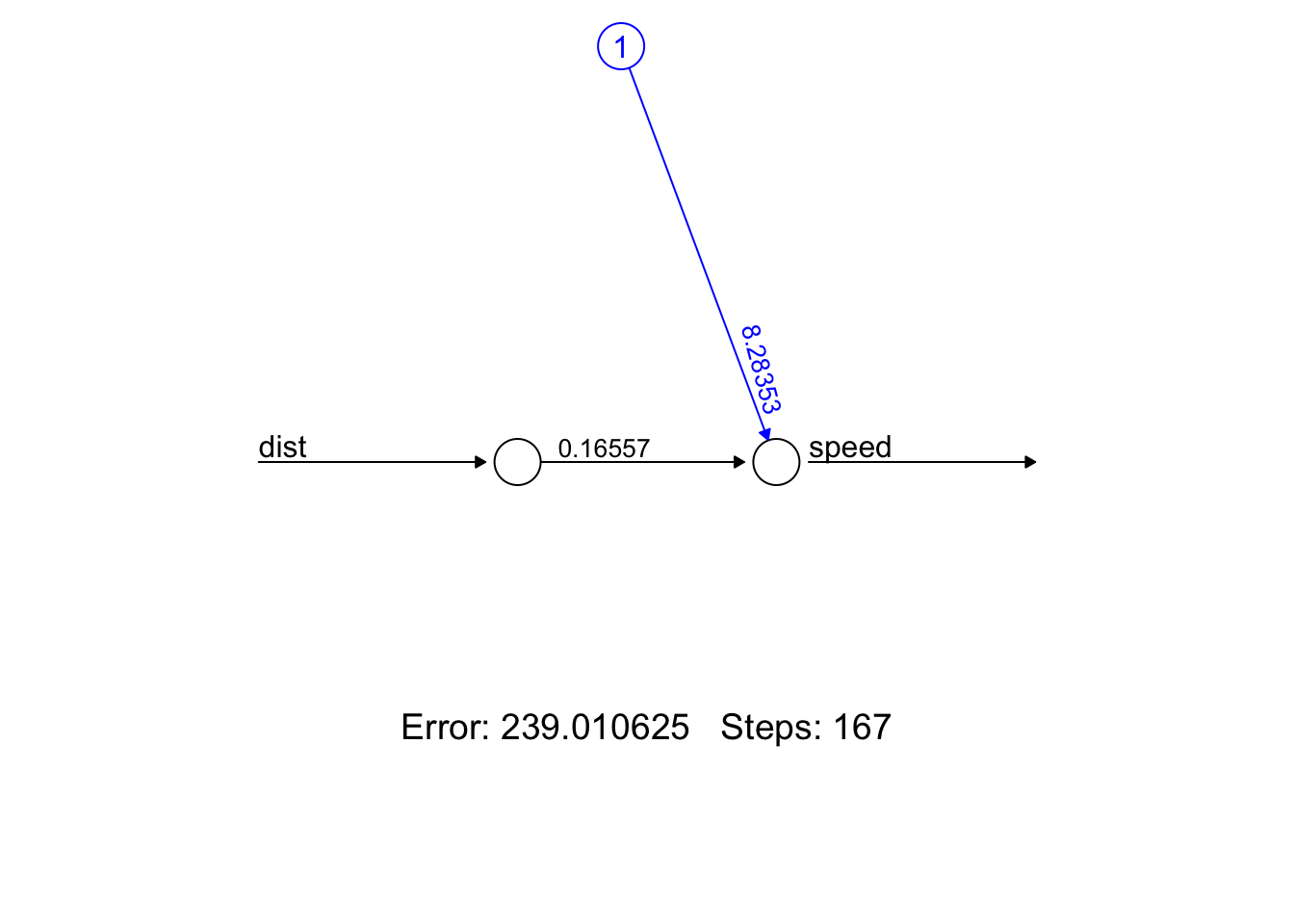
The neuralnet package uses RSS / 2 as cost function (this might be the reason)
# RSS / 2 of the linear regression model
sum(((predict(fm_lm) - cars$speed))^2) / 2
[1] 239.0106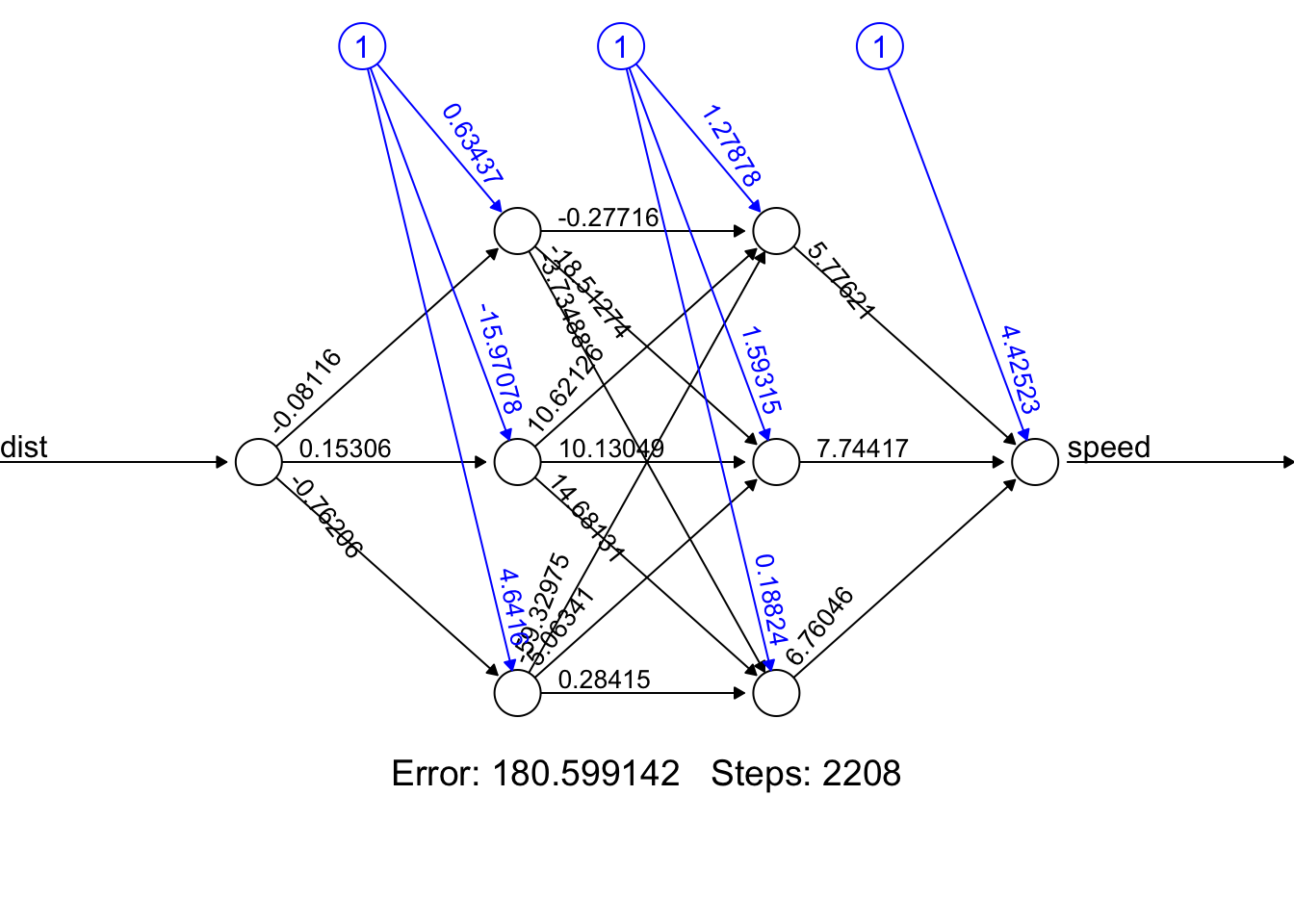
The predictions of the simple (basically linear regression) neural net and the more complex neural net plotted here:
cc <- cars |> mutate(
  nn_0_prediction = as.vector(predict(nn_0, cars)),
  nn_1_prediction = as.vector(predict(nn_1, cars))) |>
  pivot_longer(cols = c(nn_0_prediction, nn_1_prediction))

cc |>
  ggplot(aes(dist, value, color = name)) + geom_line(linewidth = 2) +
  geom_point(aes(dist, speed, color = 'original data'), data = cars) +
  labs(y = 'speed', color = 'Group')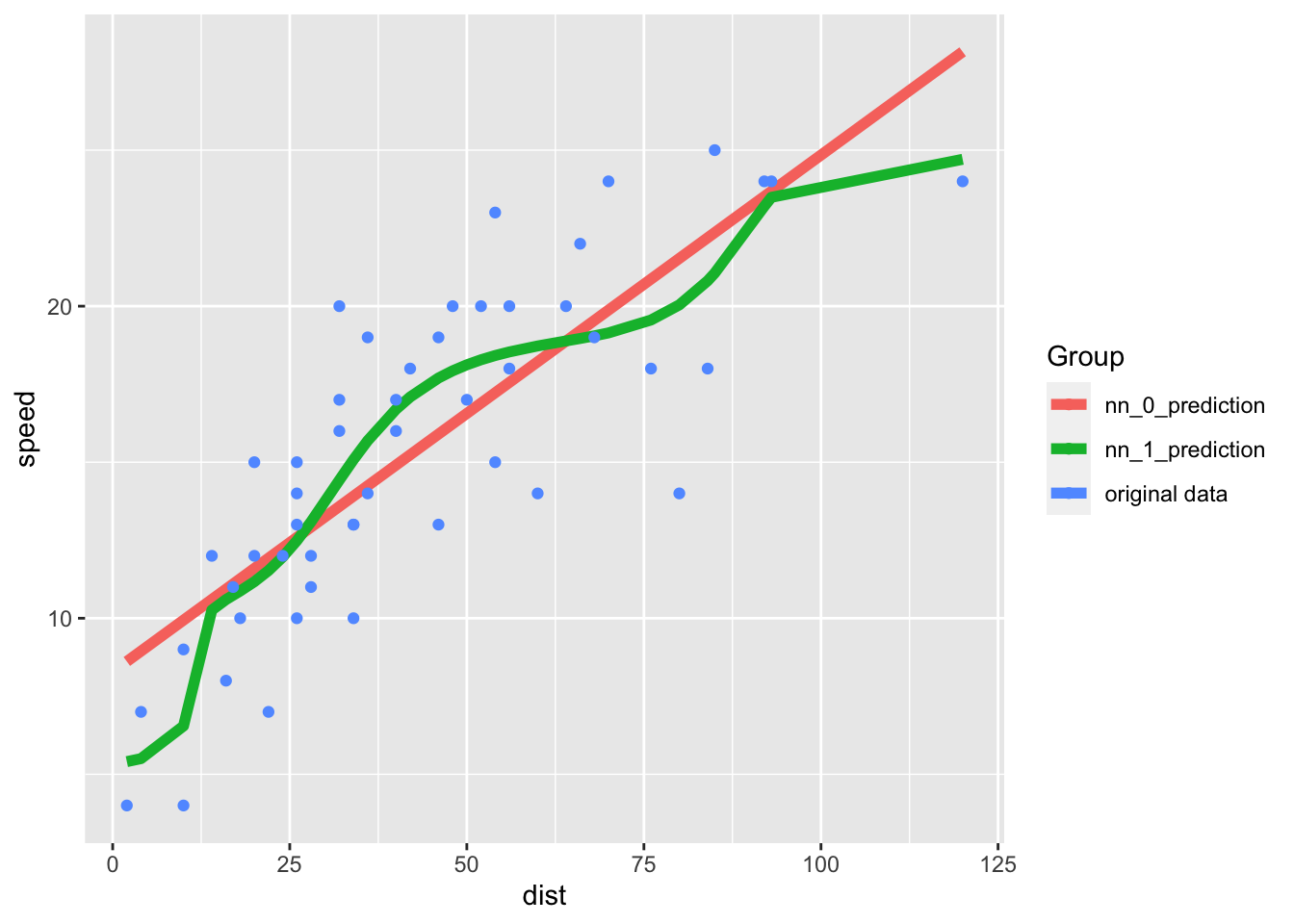
The residual sum of squares is (as expected) less in the more complex model:
cc |>
  group_by(name) |>
  summarize(RSS = sum((value - speed)^2)) |>
kable(align = 'c', digits = 2)| name | RSS |
|---|---|
| nn_0_prediction | 478.02 |
| nn_1_prediction | 361.20 |